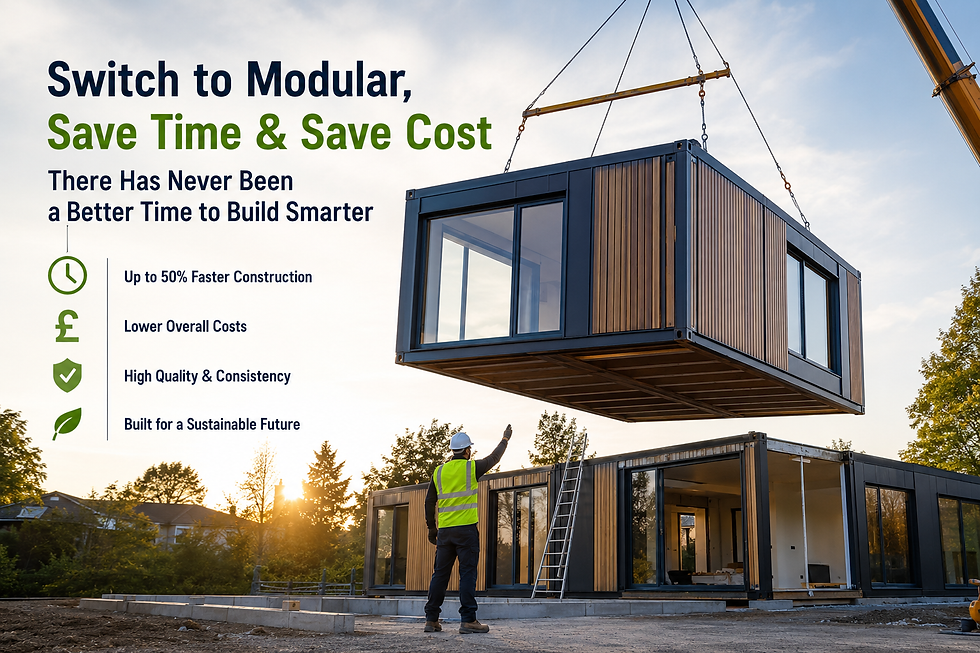
Why Modular Construction Is Ideal for Pods for Rough Sleepers
- Feb 13
- 2 min read
Providing safe, dignified shelter for rough sleepers is an urgent social challenge. Solutions must be fast to deploy, cost-effective, durable, and humane—while also being flexible enough to adapt to changing needs and locations. Modular construction meets these requirements better than almost any traditional building approach, making it an excellent foundation for sleeper pods designed specifically for rough sleepers.
1. Rapid Response to Immediate Need
Rough sleeping is a crisis that cannot wait for lengthy construction timelines. Modular construction allows housing providers and local authorities to act quickly:
Pods are manufactured off-site while groundwork or permissions are finalized
Installation can take days instead of months
Entire shelter sites can be operational in a fraction of the time
This speed is critical during winter months, extreme weather events, or sudden increases in homelessness.
2. Consistent Quality, Safety, and Dignity
Every pod should offer more than just a roof—it should provide privacy, warmth, and security. Factory-built modular pods ensure:
Reliable insulation and weatherproofing
Secure doors and controlled access
Consistent internal layouts that meet safety and wellbeing standards
Unlike ad-hoc or improvised shelters, modular pods deliver predictable living conditions, helping residents feel safer and more respected.
3. Scalable and Flexible Deployment
The population of rough sleepers can fluctuate due to economic pressures, policy changes, or seasonal factors. Modular construction supports this reality:
Pods can be added, removed, or relocated as demand changes
Sites can start small and scale up incrementally
Units can be reused across multiple locations over their lifespan
This flexibility allows councils and charities to invest in infrastructure that adapts over time, rather than locking resources into a single fixed site.
4. Lower Cost, Higher Impact
Budgets for homelessness services are often constrained. Modular construction helps stretch funding further by:
Reducing labor and construction time
Minimizing material waste through factory efficiency
Lowering long-term maintenance costs due to standardized components
The result is more pods delivered per pound spent, enabling support organizations to help a greater number of people without compromising quality.
5. Sustainability and Community Acceptance
Modular pods are not only efficient—they are environmentally and socially responsible:
Factory production generates less waste and lower emissions
On-site disruption is minimal, reducing impact on surrounding neighborhoods
Thoughtful, well-designed pods integrate better into urban environments than temporary tents or makeshift shelters
This improves acceptance from local communities while aligning with broader sustainability goals.
A Practical, Humane Housing Solution
Pods for rough sleepers must balance urgency with dignity. Modular construction achieves this balance by combining speed, quality, flexibility, and cost control. It enables cities and support organizations to respond quickly while providing safe, private, and respectful spaces for people who need them most.
As homelessness continues to challenge communities worldwide, modularly constructed sleeper pods represent not just a building method—but a scalable, compassionate approach to shelter.